Instance segmentation of overlapping cells in microscopy remains challenging due to semi-transparent
structures that produce weak boundaries and mixed visual evidence in overlap regions. Existing methods
address this through local regions of interest or shape priors but lack global reasoning across
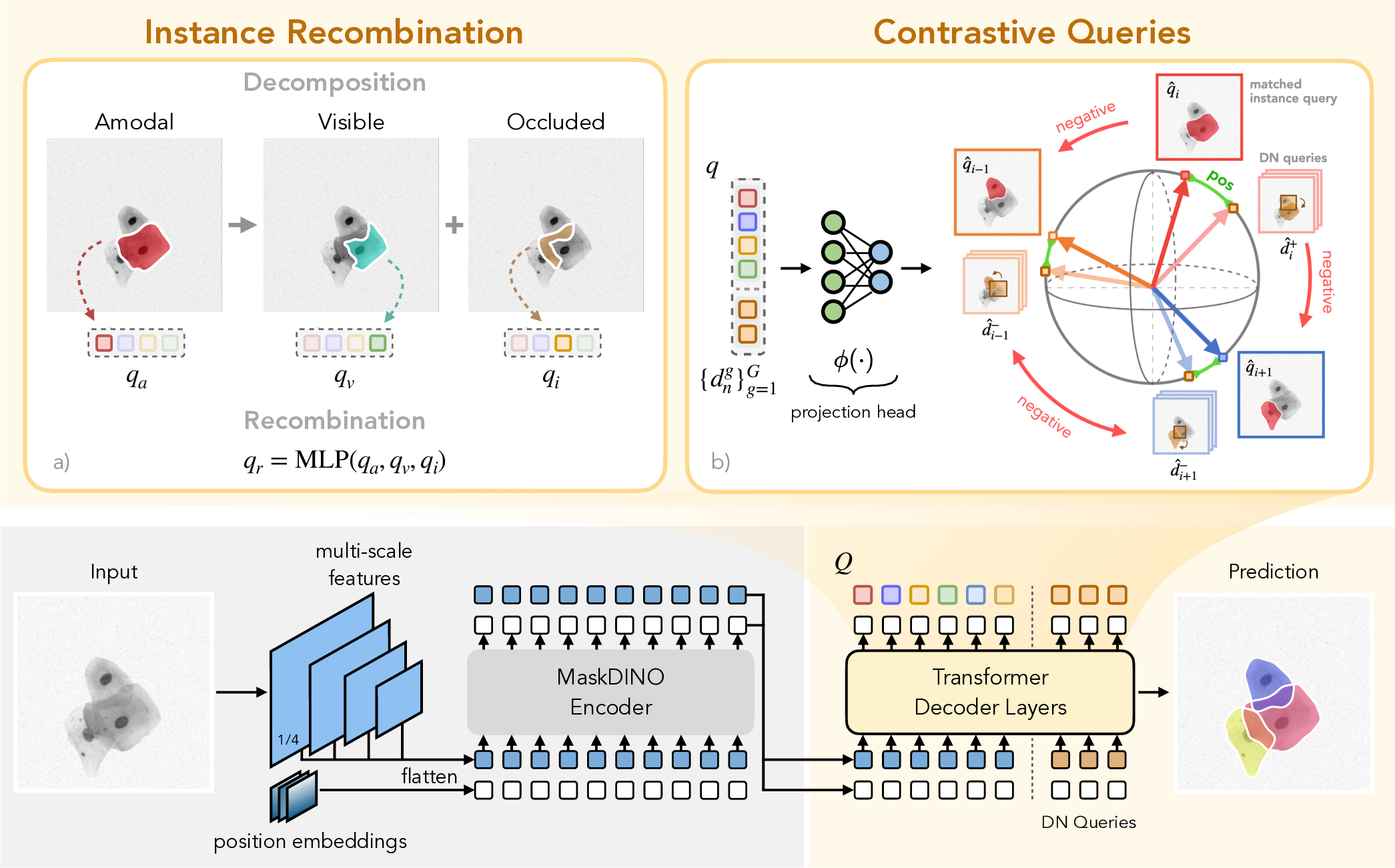
overlapping objects. We present QCell, a novel query-based model that de-overlaps cell instances
in microscopy scenes. Our approach combines (i) an instance recombination module that decomposes
and recombines query representations in latent space, enabling the model to reason about complete
object structure under overlap, and (ii) a contrastive query alignment objective that combines distinctive
instance feature learning and separation of overlapping cell queries. We additionally introduce
a new Organoid dataset benchmark for overlapping cell segmentation. We show that QCell outperforms
state-of-the-art methods across multiple benchmarks, achieving +2.2 AP and +2.7 AJI on ISBI2014.
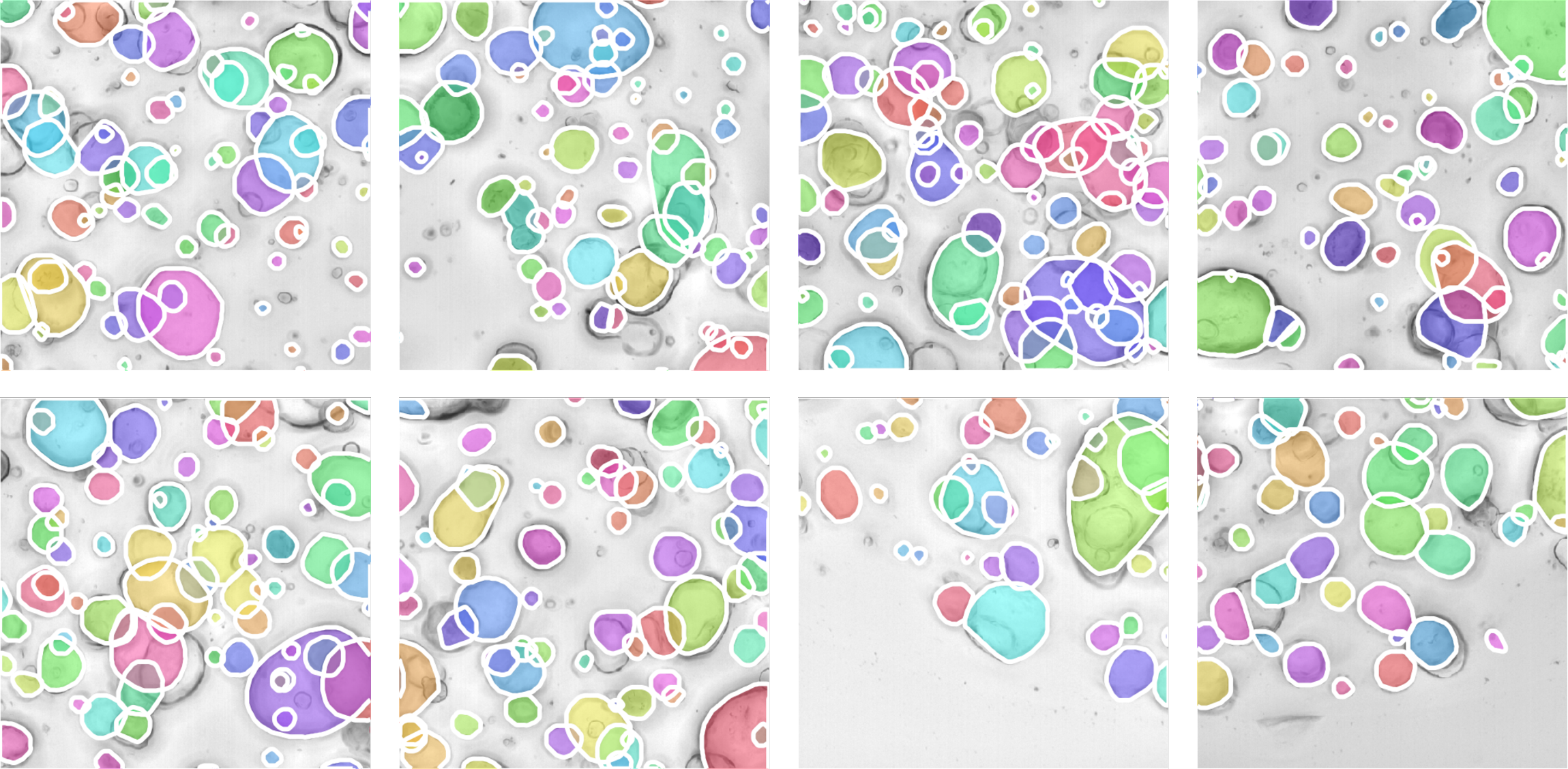
Organoids. One of our key contributions is a novel Organoids dataset for overlapping object
segmentation in brightfield microscopy. The dataset contains 1,186 training images, 1,199 validation
images, and 201 test images at a resolution of 540 × 540. The dataset presents dense and highly
overlapping scenes, with up to 105 instances per training image and an average of 96 instances per
test image, reaching a maximum of 223. This makes Organoids a challenging real-world benchmark for
evaluating instance separation and de-overlapping in microscopy. Additional dataset details are provided
in the supplementary material.
@misc{prytula2026qcellrecombiningaligningcell,
  title         = {QCell: Recombining and Aligning Cell Queries for Overlapping Instance Segmentation},
  author        = {Yaroslav Prytula and Anton Popov and Dmytro Fishman},
  year          = {2026},
  eprint        = {2608.29253},
  archivePrefix = {arXiv},
  primaryClass  = {cs.CV},
  url           = {https://arxiv.org/abs/2608.29253}
}